Magna Carta - 1215
The Magna Carta was signed by King John of England in 1215 AD. He was forced to sign it by the nobility in his kingdom. This was the first time in English history that a king's subjects forced him to admit that his actions must be governed by the law. This was one of the most important early precedents that developed into constitutional law. The Magna Carta is looked at as a founding document in English and American history and as a precursor to the United States Constitution. Magna Carta literally means Great Paper in Latin.

Magna Carta
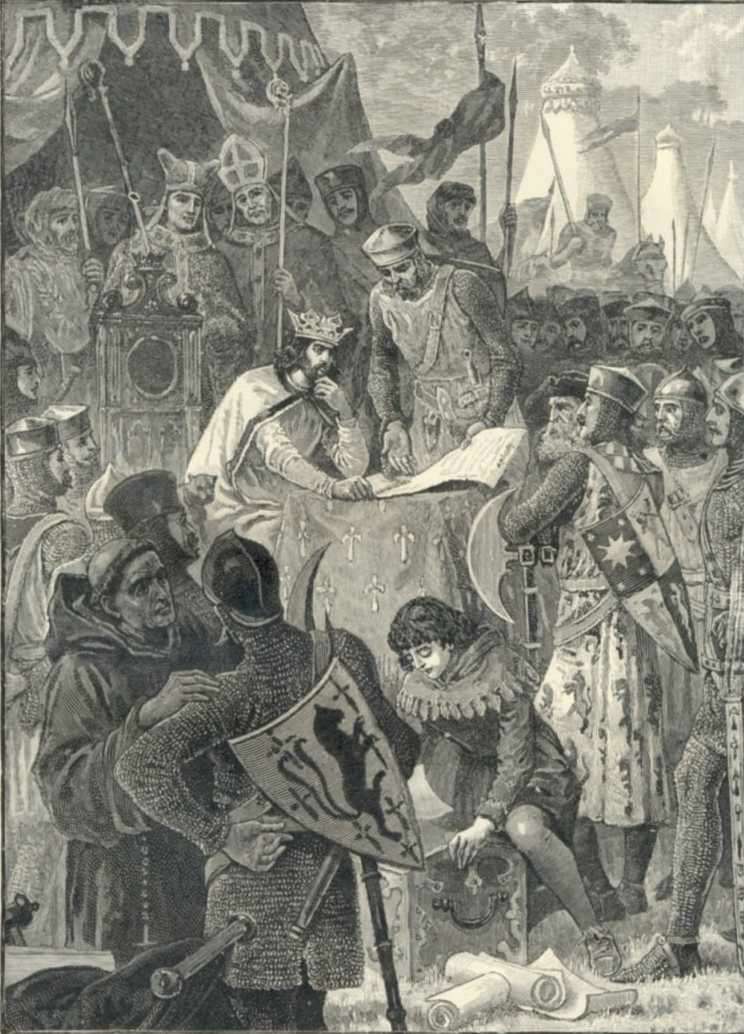 King John signing the Magna Carta
John, by the grace of God, king of England, lord of Ireland, duke of Normandy and Aquitaine, and count of Anjou, to the archbishop, bishops, abbots, earls, barons, justiciaries, foresters, sheriffs, stewards, servants, and to all his bailiffs and liege subjects, greetings. Know that, having regard to God and for the salvation of our soul, and those of all our ancestors and heirs, and unto the honor of God and the advancement of his holy Church and for the rectifying of our realm, we have granted as underwritten by advice of our venerable fathers, Stephen, archbishop of Canterbury, primate of all England and cardinal of the holy Roman Church, Henry, archbishop of Dublin, William of London, Peter of Winchester, Jocelyn of Bath and Glastonbury, Hugh of Lincoln, Walter of Worcester, William of Coventry, Benedict of Rochester, bishops; of Master Pandulf, subdeacon and member of the household of our lord the Pope, of brother Aymeric (master of the Knights of the Temple in England), and of the illustrious men William Marshal, earl of Pembroke, William, earl of Salisbury, William, earl of Warenne, William, earl of Arundel, Alan of Galloway (constable of Scotland), Waren Fitz Gerold, Peter Fitz Herbert, Hubert De Burgh (seneschal of Poitou), Hugh de Neville, Matthew Fitz Herbert, Thomas Basset, Alan Basset, Philip d'Aubigny, Robert of Roppesley, John Marshal, John Fitz Hugh, and others, our liegemen.
I. In the first place we have granted to God, and by this our present charter confirmed for us and our heirs forever that the English Church shall be free, and shall have her rights entire, and her liberties inviolate; and we will that it be thus observed; which is apparent from this that the freedom of elections, which is reckoned most important and very essential to the English Church, we, of our pure and unconstrained will, did grant, and did by our charter confirm and did obtain the ratification of the same from our lord, Pope Innocent III, before the quarrel arose between us and our barons: and this we will observe, and our will is that it be observed in good faith by our heirs forever. We have also granted to all freemen of our kingdom, for us and our heirs forever, all the underwritten liberties, to be had and held by them and their heirs, of us and our heirs forever.
II. If any of our earls or barons, or others holding of us in chief by military service shall have died, and at the time of his death his heir shall be full of age and owe "relief", he shall have his inheritance by the old relief, to wit, the heir or heirs of an earl, for the whole baroncy of an earl by L100; the heir or heirs of a baron, L100 for a whole barony; the heir or heirs of a knight, 100s, at most, and whoever owes less let him give less, according to the ancient custom of fees.
III. If, however, the heir of any one of the aforesaid has been under age and in wardship, let him have his inheritance without relief and without fine when he comes of age.
IV. The guardian of the land of an heir who is thus under age, shall take from the land of the heir nothing but reasonable produce, reasonable customs, and reasonable services, and that without destruction or waste of men or goods; and if we have committed the wardship of the lands of any such minor to the sheriff, or to any other who is responsible to us for its issues, and he has made destruction or waster of what he holds in wardship, we will take of him amends, and the land shall be committed to two lawful and discreet men of that fee, who shall be responsible for the issues to us or to him to whom we shall assign them; and if we have given or sold the wardship of any such land to anyone and he has therein made destruction or waste, he shall lose that wardship, and it shall be transferred to two lawful and discreet men of that fief, who shall be responsible to us in like manner as aforesaid.
V. The guardian, moreover, so long as he has the wardship of the land, shall keep up the houses, parks, fishponds, stanks, mills, and other things pertaining to the land, out of the issues of the same land; and he shall restore to the heir, when he has come to full age, all his land, stocked with ploughs and wainage, according as the season of husbandry shall require, and the issues of the land can reasonable bear.
VI. Heirs shall be married without disparagement, yet so that before the marriage takes place the nearest in blood to that heir shall have notice.
VII. A widow, after the death of her husband, shall forthwith and without difficulty have her marriage portion and inheritance; nor shall she give anything for her dower, or for her marriage portion, or for the inheritance which her husband and she held on the day of the death of that husband; and she may remain in the house of her husband for forty days after his death, within which time her dower shall be assigned to her.
VIII. No widow shall be compelled to marry, so long as she prefers to live without a husband; provided always that she gives security not to marry without our consent, if she holds of us, or without the consent of the lord of whom she holds, if she holds of another.
IX. Neither we nor our bailiffs will seize any land or rent for any debt, as long as the chattels of the debtor are sufficient to repay the debt; nor shall the sureties of the debtor be distrained so long as the principal debtor is able to satisfy the debt; and if the principal debtor shall fail to pay the debt, having nothing wherewith to pay it, then the sureties shall answer for the debt; and let them have the lands and rents of the debtor, if they desire them, until they are indemnified for the debt which they have paid for him, unless the principal debtor can show proof that he is discharged thereof as against the said sureties.
X. If one who has borrowed from the Jews any sum, great or small, die before that loan be repaid, the debt shall not bear interest while the heir is under age, of whomsoever he may hold; and if the debt fall into our hands, we will not take anything except the principal sum contained in the bond.
XI. And if anyone die indebted to the Jews, his wife shall have her dower and pay nothing of that debt; and if any children of the deceased are left under age, necessaries shall be provided for them in keeping with the holding of the deceased; and out of the residue the debt shall be paid, reserving, however, service due to feudal lords; in like manner let it be done touching debts due to others than Jews.
XII. No scutage not aid shall be imposed on our kingdom, unless by common counsel of our kingdom, except for ransoming our person, for making our eldest son a knight, and for once marrying our eldest daughter; and for these there shall not be levied more than a reasonable aid. In like manner it shall be done concerning aids from the city of London.
XIII. And the city of London shall have all it ancient liberties and free customs, as well by land as by water; furthermore, we decree and grant that all other cities, boroughs, towns, and ports shall have all their liberties and free customs.
XIV. And for obtaining the common counsel of the kingdom anent the assessing of an aid (except in the three cases aforesaid) or of a scutage, we will cause to be summoned the archbishops, bishops, abbots, earls, and greater barons, severally by our letters; and we will moreover cause to be summoned generally, through our sheriffs and bailiffs, and others who hold of us in chief, for a fixed date, namely, after the expiry of at least forty days, and at a fixed place; and in all letters of such summons we will specify the reason of the summons. And when the summons has thus been made, the business shall proceed on the day appointed, according to the counsel of such as are present, although not all who were summoned have come.
XV. We will not for the future grant to anyone license to take an aid from his own free tenants, except to ransom his person, to make his eldest son a knight, and once to marry his eldest daughter; and on each of these occasions there shall be levied only a reasonable aid.
XVI. No one shall be distrained for performance of greater service for a knight's fee, or for any other free tenement, than is due therefrom.
XVII. Common pleas shall not follow our court, but shall be held in some fixed place.
XVIII. Inquests of novel disseisin, of mort d'ancestor, and of darrein presentment shall not be held elsewhere than in their own county courts, and that in manner following; We, or, if we should be out of the realm, our chief justiciar, will send two justiciaries through every county four times a year, who shall alone with four knights of the county chosen by the county, hold the said assizes in the county court, on the day and in the place of meeting of that court.
XIX. And if any of the said assizes cannot be taken on the day of the county court, let there remain of the knights and freeholders, who were present at the county court on that day, as many as may be required for the efficient making of judgments, according as the business be more or less.
XX. A freeman shall not be amerced for a slight offense, except in accordance with the degree of the offense; and for a grave offense he shall be amerced in accordance with the gravity of the offense, yet saving always his "contentment"; and a merchant in the same way, saving his "merchandise"; and a villein shall be amerced in the same way, saving his "wainage" if they have fallen into our mercy: and none of the aforesaid amercements shall be imposed except by the oath of honest men of the neighborhood.
XXI. Earls and barons shall not be amerced except through their peers, and only in accordance with the degree of the offense.
XXII. A clerk shall not be amerced in respect of his lay holding except after the manner of the others aforesaid; further, he shall not be amerced in accordance with the extent of his ecclesiastical benefice.
XXIII. No village or individual shall be compelled to make bridges at river banks, except those who from of old were legally bound to do so.
XXIV. No sheriff, constable, coroners, or others of our bailiffs, shall hold pleas of our Crown.
XXV. All counties, hundred, wapentakes, and trithings (except our demesne manors) shall remain at the old rents, and without any additional payment.
XXVI. If anyone holding of us a lay fief shall die, and our sheriff or bailiff shall exhibit our letters patent of summons for a debt which the deceased owed us, it shall be lawful for our sheriff or bailiff to attach and enroll the chattels of the deceased, found upon the lay fief, to the value of that debt, at the sight of law worthy men, provided always that nothing whatever be thence removed until the debt which is evident shall be fully paid to us; and the residue shall be left to the executors to fulfill the will of the deceased; and if there be nothing due from him to us, all the chattels shall go to the deceased, saving to his wife and children their reasonable shares.
XXVII. If any freeman shall die intestate, his chattels shall be distributed by the hands of his nearest kinsfolk and friends, under supervision of the Church, saving to every one the debts which the deceased owed to him.
XXVIII. No constable or other bailiff of ours shall take corn or other provisions from anyone without immediately tendering money therefor, unless he can have postponement thereof by permission of the seller.
XXIX. No constable shall compel any knight to give money in lieu of castle-guard, when he is willing to perform it in his own person, or (if he himself cannot do it from any reasonable cause) then by another responsible man. Further, if we have led or sent him upon military service, he shall be relieved from guard in proportion to the time during which he has been on service because of us.
XXX. No sheriff or bailiff of ours, or other person, shall take the horses or carts of any freeman for transport duty, against the will of the said freeman.
XXXI. Neither we nor our bailiffs shall take, for our castles or for any other work of ours, wood which is not ours, against the will of the owner of that wood.
XXXII. We will not retain beyond one year and one day, the lands those who have been convicted of felony, and the lands shall thereafter be handed over to the lords of the fiefs.
XXXIII. All kydells for the future shall be removed altogether from Thames and Medway, and throughout all England, except upon the seashore.
XXXIV. The writ which is called praecipe shall not for the future be issued to anyone, regarding any tenement whereby a freeman may lose his court.
XXXV. Let there be one measure of wine throughout our whole realm; and one measure of ale; and one measure of corn, to wit, "the London quarter"; and one width of cloth (whether dyed, or russet, or "halberget"), to wit, two ells within the selvedges; of weights also let it be as of measures.
XXXVI. Nothing in future shall be given or taken for awrit of inquisition of life or limbs, but freely it shall be granted, and never denied.
XXXVII. If anyone holds of us by fee-farm, either by socage or by burgage, or of any other land by knight's service, we will not (by reason of that fee-farm, socage, or burgage), have the wardship of the heir, or of such land of his as if of the fief of that other; nor shall we have wardship of that fee-farm, socage, or burgage, unless such fee-farm owes knight's service. We will not by reason of any small serjeancy which anyone may hold of us by the service of rendering to us knives, arrows, or the like, have wardship of his heir or of the land which he holds of another lord by knight's service.
XXXVIII. No bailiff for the future shall, upon his own unsupported complaint, put anyone to his "law", without credible witnesses brought for this purposes.
XXXIX. No freemen shall be taken or imprisoned or disseised or exiled or in any way destroyed, nor will we go upon him nor send upon him, except by the lawful judgment of his peers or by the law of the land.
XL. To no one will we sell, to no one will we refuse or delay, right or justice.
XLI. All merchants shall have safe and secure exit from England, and entry to England, with the right to tarry there and to move about as well by land as by water, for buying and selling by the ancient and right customs, quit from all evil tolls, except (in time of war) such merchants as are of the land at war with us. And if such are found in our land at the beginning of the war, they shall be detained, without injury to their bodies or goods, until information be received by us, or by our chief justiciar, how the merchants of our land found in the land at war with us are treated; and if our men are safe there, the others shall be safe in our land.
XLII. It shall be lawful in future for anyone (excepting always those imprisoned or outlawed in accordance with the law of the kingdom, and natives of any country at war with us, and merchants, who shall be treated as if above provided) to leave our kingdom and to return, safe and secure by land and water, except for a short period in time of war, on grounds of public policy- reserving always the allegiance due to us.
XLIII. If anyone holding of some escheat (such as the honor of Wallingford, Nottingham, Boulogne, Lancaster, or of other escheats which are in our hands and are baronies) shall die, his heir shall give no other relief, and perform no other service to us than he would have done to the baron if that barony had been in the baron's hand; and we shall hold it in the same manner in which the baron held it.
XLIV. Men who dwell without the forest need not henceforth come before our justiciaries of the forest upon a general summons, unless they are in plea, or sureties of one or more, who are attached for the forest.
XLV. We will appoint as justices, constables, sheriffs, or bailiffs only such as know the law of the realm and mean to observe it well.
XLVI. All barons who have founded abbeys, concerning which they hold charters from the kings of England, or of which they have long continued possession, shall have the wardship of them, when vacant, as they ought to have.
XLVII. All forests that have been made such in our time shall forthwith be disafforsted; and a similar course shall be followed with regard to river banks that have been placed "in defense" by us in our time.
XLVIII. All evil customs connected with forests and warrens, foresters and warreners, sheriffs and their officers, river banks and their wardens, shall immediately by inquired into in each county by twelve sworn knights of the same county chosen by the honest men of the same county, and shall, within forty days of the said inquest, be utterly abolished, so as never to be restored, provided always that we previously have intimation thereof, or our justiciar, if we should not be in England.
XLVIX. We will immediately restore all hostages and charters delivered to us by Englishmen, as sureties of the peace of faithful service.
L. We will entirely remove from their bailiwicks, the relations of Gerard of Athee (so that in future they shall have no bailiwick in England); namely, Engelard of Cigogne, Peter, Guy, and Andrew of Chanceaux, Guy of Cigogne, Geoffrey of Martigny with his brothers, Philip Mark with his brothers and his nephew Geoffrey, and the whole brood of the same.
LI. As soon as peace is restored, we will banish from the kingdom all foreign born knights, crossbowmen, serjeants, and mercenary soldiers who have come with horses and arms to the kingdom's hurt.
LII. If anyone has been dispossessed or removed by us, without the legal judgment of his peers, from his lands, castles, franchises, or from his right, we will immediately restore them to him; and if a dispute arise over this, then let it be decided by the five and twenty barons of whom mention is made below in the clause for securing the peace. Moreover, for all those possessions, from which anyone has, without the lawful judgment of his peers, been disseised or removed, by our father, King Henry, or by our brother, King Richard, and which we retain in our hand (or which as possessed by others, to whom we are bound to warrant them) we shall have respite until the usual term of crusaders; excepting those things about which a plea has been raised, or an inquest made by our order, before our taking of the cross; but as soon as we return from the expedition, we will immediately grant full justice therein.
LIII. We shall have, moreover, the same respite and in the same manner in rendering justice concerning the disafforestation or retention of those forests which Henry our father and Richard our brother afforested, and concerning the wardship of lands which are of the fief of another (namely, such wardships as we have hitherto had by reason of a fief which anyone held of us by knight's service), and concerning abbeys founded on other fiefs than our own, in which the lord of the fee claims to have right; and when we have returned, or if we desist from our expedition, we will immediately grant full justice to all who complain of such things.
LIV. No one shall be arrested or imprisoned upon the appeal of a woman, for the death of any other than her husband.
LV. All fines made with us unjustly and against the law of the land, and all amercements, imposed unjustly and against the law of the land, shall be entirely remitted, or else it shall be done concerning them according to the decision of the five and twenty barons whom mention is made below in the clause for securing the pease, or according to the judgment of the majority of the same, along with the aforesaid Stephen, archbishop of Canterbury, if he can be present, and such others as he may wish to bring with him for this purpose, and if he cannot be present the business shall nevertheless proceed without him, provided always that if any one or more of the aforesaid five and twenty barons are in a similar suit, they shall be removed as far as concerns this particular judgment, others being substituted in their places after having been selected by the rest of the same five and twenty for this purpose only, and after having been sworn.
LVI. If we have disseised or removed Welshmen from lands or liberties, or other things, without the legal judgment of their peers in England or in Wales, they shall be immediately restored to them; and if a dispute arise over this, then let it be decided in the marches by the judgment of their peers; for the tenements in England according to the law of England, for tenements in Wales according to the law of Wales, and for tenements in the marches according to the law of the marches. Welshmen shall do the same to us and ours.
LVII. Further, for all those possessions from which any Welshman has, without the lawful judgment of his peers, been disseised or removed by King Henry our father, or King Richard our brother, and which we retain in our hand (or which are possessed by others, and which we ought to warrant), we will have respite until the usual term of crusaders; excepting those things about which a plea has been raised or an inquest made by our order before we took the cross; but as soon as we return (or if perchance we desist from our expedition), we will immediately grant full justice in accordance with the laws of the Welsh and in relation to the foresaid regions.
LVIII. We will immediately give up the son of Llywelyn and all the hostages of Wales, and the charters delivered to us as security for the peace.
LIX. We will do towards Alexander, king of Scots, concerning the return of his sisters and his hostages, and concerning his franchises, and his right, in the same manner as we shall do towards our other barons of England, unless it ought to be otherwise according to the charters which we hold from William his father, formerly king of Scots; and this shall be according to the judgment of his peers in our court.
LX. Moreover, all these aforesaid customs and liberties, the observances of which we have granted in our kingdom as far as pertains to us towards our men, shall be observed by all of our kingdom, as well clergy as laymen, as far as pertains to them towards their men.
LXI. Since, moreover, for God and the amendment of our kingdom and for the better allaying of the quarrel that has arisen between us and our barons, we have granted all these concessions, desirous that they should enjoy them in complete and firm endurance forever, we give and grant to them the underwritten security, namely, that the barons choose five and twenty barons of the kingdom, whomsoever they will, who shall be bound with all their might, to observe and hold, and cause to be observed, the peace and liberties we have granted and confirmed to them by this our present Charter, so that if we, or our justiciar, or our bailiffs or any one of our officers, shall in anything be at fault towards anyone, or shall have broken any one of the articles of this peace or of this security, and the offense be notified to four barons of the foresaid five and twenty, the said four barons shall repair to us (or our justiciar, if we are out of the realm) and, laying the transgression before us, petition to have that transgression redressed without delay. And if we shall not have corrected the transgression (or, in the event of our being out of the realm, if our justiciar shall not have corrected it) within forty days, reckoning from the time it has been intimated to us (or to our justiciar, if we should be out of the realm), the four barons aforesaid shall refer that matter to the rest of the five and twenty barons, and those five and twenty barons shall, together with the community of the whole realm, distrain and distress us in all possible ways, namely, by seizing our castles, lands, possessions, and in any other way they can, until redress has been obtained as they deem fit, saving harmless our own person, and the persons of our queen and children; and when redress has been obtained, they shall resume their old relations towards us. And let whoever in the country desires it, swear to obey the orders of the said five and twenty barons for the execution of all the aforesaid matters, and along with them, to molest us to the utmost of his power; and we publicly and freely grant leave to everyone who wishes to swear, and we shall never forbid anyone to swear. All those, moreover, in the land who of themselves and of their own accord are unwilling to swear to the twenty five to help them in constraining and molesting us, we shall by our command compel the same to swear to the effect foresaid. And if any one of the five and twenty barons shall have died or departed from the land, or be incapacitated in any other manner which would prevent the foresaid provisions being carried out, those of the said twenty five barons who are left shall choose another in his place according to their own judgment, and he shall be sworn in the same way as the others. Further, in all matters, the execution of which is entrusted,to these twenty five barons, if perchance these twenty five are present and disagree about anything, or if some of them, after being summoned, are unwilling or unable to be present, that which the majority of those present ordain or command shall be held as fixed and established, exactly as if the whole twenty five had concurred in this; and the said twenty five shall swear that they will faithfully observe all that is aforesaid, and cause it to be observed with all their might. And we shall procure nothing from anyone, directly or indirectly, whereby any part of these concessions and liberties might be revoked or diminished; and if any such things has been procured, let it be void and null, and we shall never use it personally or by another.
LXII. And all the will, hatreds, and bitterness that have arisen between us and our men, clergy and lay, from the date of the quarrel, we have completely remitted and pardoned to everyone. Moreover, all trespasses occasioned by the said quarrel, from Easter in the sixteenth year of our reign till the restoration of peace, we have fully remitted to all, both clergy and laymen, and completely forgiven, as far as pertains to us. And on this head, we have caused to be made for them letters testimonial patent of the lord Stephen, archbishop of Canterbury, of the lord Henry, archbishop of Dublin, of the bishops aforesaid, and of Master Pandulf as touching this security and the concessions aforesaid.
LXIII. Wherefore we will and firmly order that the English Church be free, and that the men in our kingdom have and hold all the aforesaid liberties, rights, and concessions, well and peaceably, freely and quietly, fully and wholly, for themselves and their heirs, of us and our heirs, in all respects and in all places forever, as is aforesaid. An oath, moreover, has been taken, as well on our part as on the part of the barons, that all these conditions aforesaid shall be kept in good faith and without evil intent. Given under our hand - the above named and many others being witnesses - in the meadow which is called Runnymede, between Windsor and Staines, on the fifteenth day of June, in the seventeenth year of our reign.
Read the text of the US Constitution here.
Revolutionary War and Beyond Home
Like This Page?
© 2008 - 2022 Revolutionary-War-and-Beyond.com Dan & Jax Bubis
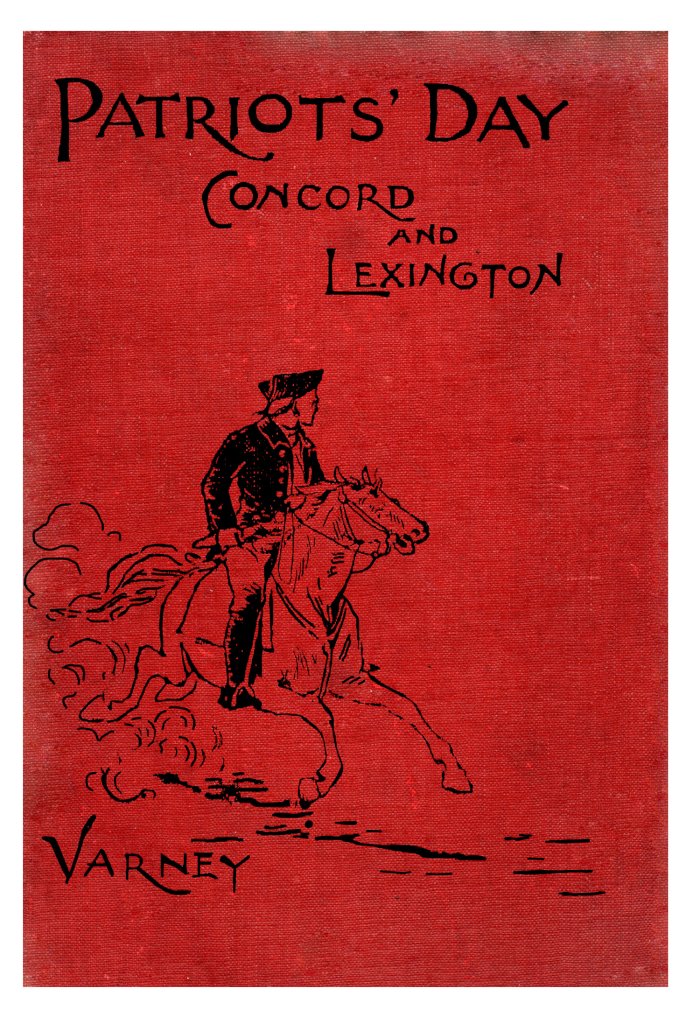
This book is as exact a reproduction of this wonderful little book published in 1895 as we could produce. You will find words spelled and hyphenated the way they are in the original.
Our goal at Battle Road Books is to keep the history of the Revolutionary War alive and vibrant and easily accessible. We also don’t think you should pay an arm and a leg just to read these old books.

Get your Favorite Flag on a coffee mug. Or maybe your favorite Founding Fathers Quote on a travel mug. Custom Orders welcome.

Visit our Sister Site - Revive 1775

YES! You can now sponsor your favorite page on Revolutionary War and Beyond. Click below for information.



Homepage | Newsletter | Causes | Declaration | Bill of Rights | Founders
Facts | Flags | Quotes | Games | Attractions | Documents | Blog | Store | Advertise
 |
|
Privacy | Sitemap | Citations | Contact
Revolutionary War and Beyond © 2008-2019
Facebook Comments