Thomas Jefferson Quotes
1790-1798

These Thomas Jefferson Quotes are from his own writings and personal
letters between 1790 and 1798. During this time, Jefferson served as Secretary of State
under President George Washington and Vice-President under
President John Adams. Many of these Thomas Jefferson Quotes
come from letters to such people as George Washington, Noah
Webster and Elbridge Gerry. Others come from his writings on
such topics as the Constitutionality of a National Bank and the Kentucky
Resolutions, which advocated the position that the federal government could
not do anything it was not delegated in the Constitution. Thomas Jefferson
is one of the great heros of the Revolutionary War. He was the main
author of the Declaration of Independence and served as Ambassador
to France, Secretary of State, Vice President and 3rd President of the United
States. These Thomas Jefferson Quotes are listed chronologically
with links to more both before and after this time period at the bottom.

Thomas Jefferson Quotes
"It had become an universal and almost uncontroverted Position in the several States,
that the purposes of society do not require a surrender of all our rights to our
ordinary governors: that there are certain portions of right not necessary to enable
them to carry on an effective government, and which experience has nevertheless
proved they will be constantly encroaching on, if submitted to them: that there
are also certain fences which experience has proved peculiarly efficacious against
wrong, and rarely obstructive of right, which yet the governing powers have ever
shown a disposition to weaken and remove. Of the first kind, for instance, is
freedom of religion: of the second, trial by jury, habeus corpus laws, free
presses." - Letter to Noah Webster, December 4, 1790
"It is not honorable to take mere legal advantage, when it happens to be contrary
to justice." - Opinion on Debts Due to Soldiers, 1790
"Hamilton was indeed a singular character. Of acute understanding, disinterested,
honest, and honorable in all private transactions, amiable in society, and duly
valuing virtue in private life, yet so bewitched & perverted by the British
example, as to be under thoro' conviction that corruption was essential to the
government of a nation." - On Alexander Hamilton in The Anas, 1791-1806
"It is an established rule of construction, where a phrase will bear either of
two meanings to give it that which will allow some meaning to the other parts
of the instrument, and not that which will render all the others useless. Certainly
no such universal power was meant to be given to them. It was intended to lace them
up straightly with in the enumerated powers, and those without which, as means,
these powers could not be carried into effect." - Opinion on the Constitutionality
of a National Bank, February 15, 1791
"The incorporation of a bank and the powers assumed (by legislation doing so) have
not, in my opinion, been delegated to the United States by the Constitution. They
are not among the powers specially enumerated." - Opinion on the Constitutionality
of a National Bank, February 15, 1791
"They are not to do anything they please to provide for the general welfare, but
only to lay taxes for that purpose. To consider the latter phrase not as describing
the purpose of the first, but as giving a distinct and independent power to do any
act they please which may be good for the Union, would render all the preceding and
subsequent enumerations of power completely useless. It would reduce the whole
instrument to a single phrase, that of instituting a Congress with power to do
whatever would be for the good of the United States; and as they sole judges of
the good or evil, it would be also a power to do whatever evil they please...
Certainly no such universal power was meant to be given them. It was intended
to lace them up straightly within the enumerated powers and those without which,
as means, these powers could not be carried into effect." - Opinion on the
Constitutionality of a National Bank, February 15, 1791
"I consider the foundation of the Constitution as laid on this ground that 'all
powers not delegated to the United States, by the Constitution, nor prohibited
by it to the states, are reserved to the states or to the people.' To take a
single step beyond the boundaries thus specially drawn around the powers of
Congress, is to take possession of a boundless field of power not longer
susceptible of any definition." - Opinion on the Constitutionality of a
National Bank, February 15, 1791
"It would reduce the whole instrument to a single phrase, that of instituting a
Congress with power to do whatever would be for the good of the United States;
and as they would be the sole judges of the good or evil, it would be also a
power to do whatever evil they please. Certainly no such universal power was
meant to be given them. It (the Constitution) was intended to lace them up
straightly within the enumerated powers and those without which, as means,
these powers could not be carried into effect." - Opinion on the
Constitutionality of a National Bank, February 15, 1791
"On the whole I find nothing any where else in point of climate which Virginia
need envy to any part of the world... Spring and autumn, which make a paradise
of our country, are rigorous winter with them (New Englanders)... When we
consider how much climate contributes to the happiness of our condition, by the
fine sensations it excites, and the productions it is the parents of, we have
reason to value highly the accident of birth in such an one as that of Virginia."
- Letter to Thomas Mann Randolph, May 31, 1791
"New England botanical specimens "either unknown or rare in Virginia" include
"an Azalea very different from the Nudiflora, with very large clusters of flowers,
more thickly set on the branches, of a deeper red and high pink fragrance. It is
the richest shrub I have seen." - Letter to Thomas Mann Randolph, June 5, 1791
"I would rather be exposed to the inconveniencies attending too much liberty
than to those attending too small a degree of it." - Letter to Archibald
Stewart, December 23, 1791
"Let what will be said or done, preserve your sang-froid immovably, and to every
obstacle, oppose patience, perseverance, and soothing language." - Letter to
William Short, March 18, 1792

"Good husbandry with us consists in abandoning Indian corn and tobacco, tending
small grain, some red clover following, and endeavoring to have, while the lands
are at rest, a spontaneous cover of white clover. I do not present this as a
culture judicious in itself, but as good in comparison with what most people
there pursue." - Letter to George
Washington, June 28, 1793
"The President was much inflamed; got into one of those passions when he cannot
command himself; ran on much on the personal abuse which had been bestowed on
him: defied any man on earth to produce one single act of his since he had been
in the government, which was not done on the purest motives; that he had never
repented but once the having slipped the moment of resigning his office, and
that was every moment since: that by God he had rather be in his grave than
in his situation ; that be had rather be On his farm than to be made Emperor
of the world; and yet that they were charging him with wanting to be a King."
- Personal Notes, August 2, 1793
"I am sorry La Motte has put me to the expense of one hundred and forty livres
for a French translation of an English poem, as I make it a rule never to read
translations where I can read the original." - Letter to Edmund Randolph,
February 3, 1794
"It (agriculture) is at the same time the most tranquil, healthy, and independent
(occupation)." - Letter to Jean Nicolas Démeunier, April 29, 1795
"In our private pursuits it is a great advantage that every honest employment is
deemed honorable. I am myself a nail-maker." - Letter to Jean Nicolas Démeunier,
April 29, 1795
"I am become the most industrious and ardent farmer of the canton..." - Letter
to Madame de Tesse, September 8, 1795
"The President, who errs as other men do, but errs with integrity." - Letter
to William Branch Giles, December 31, 1795
"The second office of this government is honorable & easy, the first is but a
splendid misery." - Letter to Elbridge Gerry, May 13, 1797
"I have been happy, however, in believing, from the stifling of this effort, that
that dose was found too strong, & excited as much repugnance there as it did
horror in other parts of our country, & that whatever follies we may be led
into as to foreign nations, we shall never give up our Union, the last anchor of
our hope, & that alone which is to prevent this heavenly country from becoming
an arena of gladiators. Much as I abhor war, and view it as the greatest scourge
of mankind, and anxiously as I wish to keep out of the broils of Europe, I would
yet go with my brethren into these, rather than separate from them. But I hope we
may still keep clear of them, notwithstanding our present thraldom, & that time
may be given us to reflect on the awful crisis we have passed through, and to find
some means of shielding ourselves in future from foreign influence, political,
commercial, or in whatever other form it may be attempted. I can scarcely withhold
myself from joining in the wish of Silas Deane, that there were an ocean of fire
between us & the old world." - Letter to Elbridge Gerry, May 13, 1797
"War is not the best engine for us to resort to; nature has given us one in our
commerce, which if properly managed, will be a better instrument for obliging the
interested nations of Europe to treat us with justice." - Letter to Thomas
Pinckney, May 29, 1797
"Harmony in the married state is the very first object to be aimed at." - Letter
to Mary Jefferson Eppes, January 7, 1798
"Every State has a natural right in cases not within the compact (casus non faederis)
to nullify of their own authority all assumptions of power by others within their
limits. Without this right, they would be under the dominion, absolute and unlimited,
of whosoever might exercise this right of judgment for them." - Draft of Kentucky
Resolutions, October, 1798
- If you liked this Thomas Jefferson Quote page, you will also like our Thomas Jefferson Facts page.
- Learn about Thomas Jefferson and the Declaration of Independence here.
More Thomas Jefferson Quotes
- Go to Thomas Jefferson Quotations page 1
- Go to Thomas Jefferson Quotations page 2
- Go to Thomas Jefferson Quotations page 3
- Go to Thomas Jefferson Quotations page 4
- Go to Thomas Jefferson Quotations page 5
- Go to Thomas Jefferson Quotations page 6
- Go to Thomas Jefferson Quotations page 7
- Go to Thomas Jefferson Quotations page 8
- Go to Thomas Jefferson Quotations page 9
- Go to Thomas Jefferson Quotations page 10
- Go to Thomas Jefferson Quotations page 11
- Go to Thomas Jefferson Quotations page 12
- Go to Thomas Jefferson Quotations page 13
- Go to Thomas Jefferson Quotations page 14
- Go to Thomas Jefferson Quotations page 15
George Washington Quotes
Ben Franklin Quotes
Thomas Paine Quotes
John Adams Quotes
James Madison Quotes
Patrick Henry Quotes
Samuel Adams Quotes
Revolutionary War and Beyond Home
Like This Page?
© 2008 - 2022 Revolutionary-War-and-Beyond.com Dan & Jax Bubis
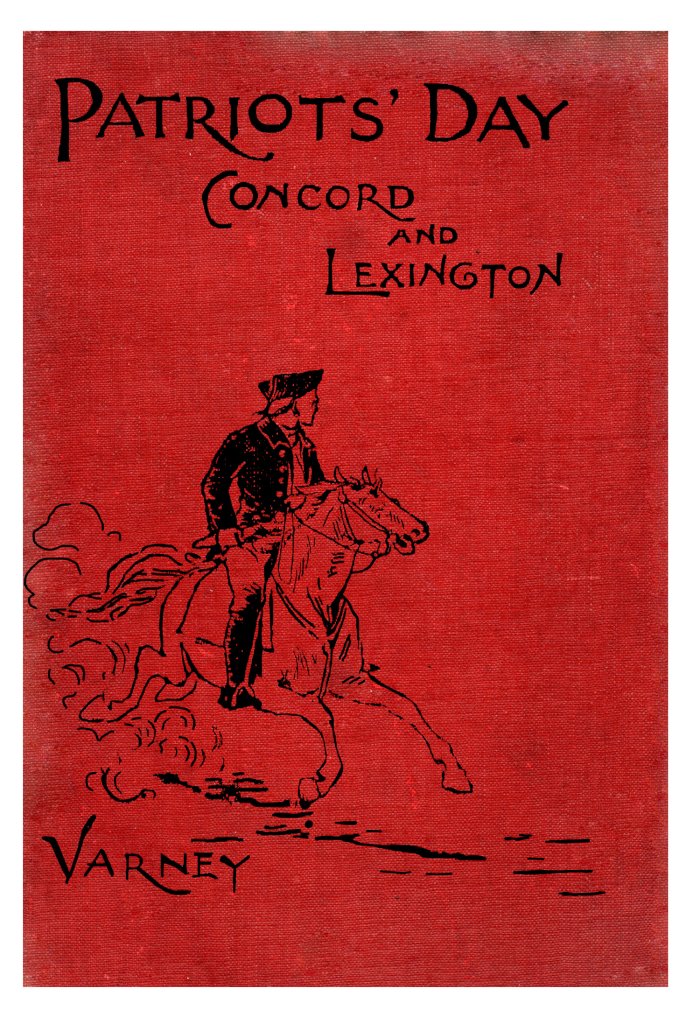
This book is as exact a reproduction of this wonderful little book published in 1895 as we could produce. You will find words spelled and hyphenated the way they are in the original.
Our goal at Battle Road Books is to keep the history of the Revolutionary War alive and vibrant and easily accessible. We also don’t think you should pay an arm and a leg just to read these old books.

Get your Favorite Flag on a coffee mug. Or maybe your favorite Founding Fathers Quote on a travel mug. Custom Orders welcome.

Visit our Sister Site - Revive 1775

YES! You can now sponsor your favorite page on Revolutionary War and Beyond. Click below for information.



Homepage | Newsletter | Causes | Declaration | Bill of Rights | Founders
Facts | Flags | Quotes | Games | Attractions | Documents | Blog | Store | Advertise
 |
|
Privacy | Sitemap | Citations | Contact
Revolutionary War and Beyond © 2008-2019
Facebook Comments