Pictures of the
Declaration
of Independence
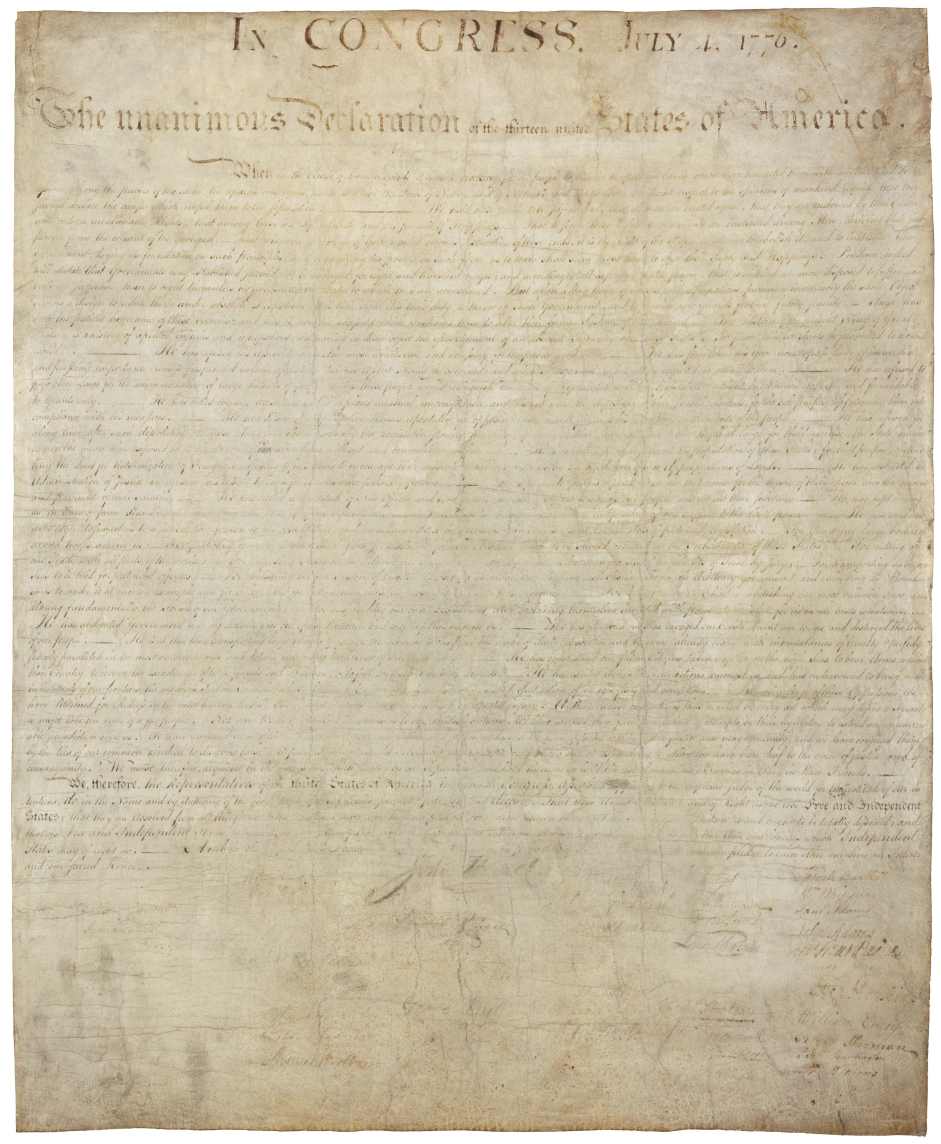
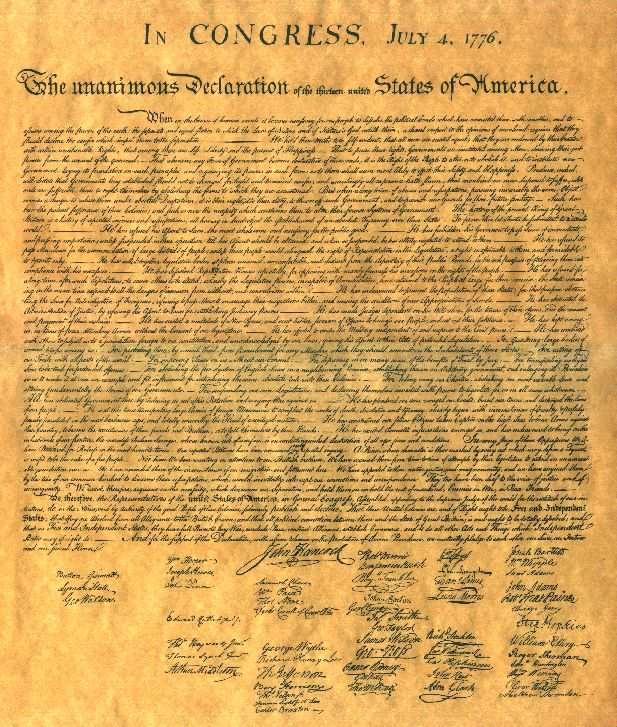
This is a picture of the original Declaration of Independence. You can view it today in person in the Rotunda of the National Archives building in Washington D.C. Notice that the original Declaration is very worn and faded. Over the years, especially in its infancy during the years of the Revolutionary War, the Declaration was subjected to fairly harsh treatment. It was rolled up, carried around in trains and wagons and copies were probably made by copper transfer. This method of copying placed a wet sheet of paper over the existing Declaration and some of the original ink was transferred to the wet sheet. Then the wet copy would be pressed on a copper plate, transferring the ink to the copper sheet. Then an artisan would engrave the copper sheet using the ink as a guide. Copies of the Declaration were then made with the copper plate.

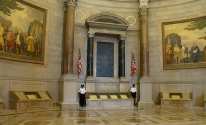
National Archives Rotunda This is the Rotunda for the Charters of Freedom at the National Archives Building in Washington D.C. It is the permanent home of the original Declaration of Independence, the original Constitution of the United States and the original Bill of Rights. The case on the left contains the Declaration of Independence; the case between the two guards contains the four pages of the Constitution and the case on the right contains the original Bill of Rights. The founding documents have been stored here since 1952.
Click here for the National Archives website
page that has information about visiting hours and directions,
so the next time you are in Washington D.C. you can go and see the
original Declaration of Independence first hand!
Click here to see a really cool 360 degree
picture of the inside of the Rotunda.
Before it was located in this building, the Declaration of Independence had a very interesting journey and was exhibited and stored in various places. Read a list showing the locations of the Declaration of Independence over the years here.
Pictures of
the Declaration of Independence -
Fragment of Thomas Jefferson's draft
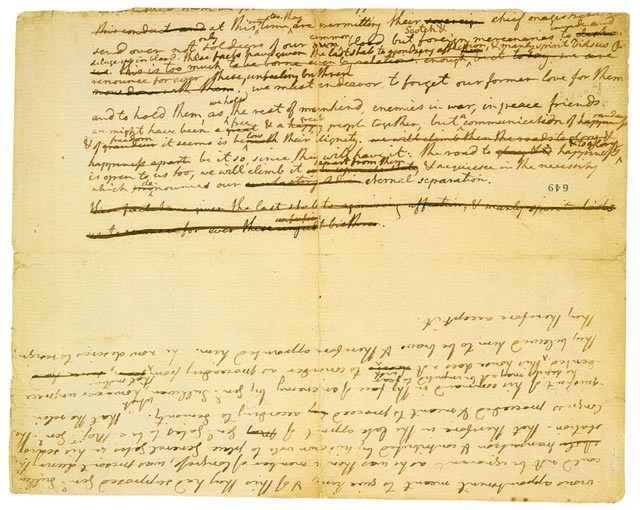

This picture is of the only existing fragment from Thomas Jefferson's original draft of the Declaration of Independence. Notice how he wrote down ideas and then scratched some of them out. Jefferson used this method to prepare his ideas and then wrote what he called a "fair copy," meaning the finished product, which he then presented to John Adams and Benjamin Franklin, who each made revisions to his draft. The draft with the changes made by John Adams and Benjamin Franklin, is typically called the "Original Rough Draft." None of the wording that is scratched out on this fragment appears in the Original Rough Draft, but all of the 148 words that are not scratched out do appear on it. There is also some writing at the bottom of the fragment that is a draft Jefferson was writing of a resolution regarding the acceptance of General John Sullivan's resignation. Click here to read the text on this fragment.
Pictures of
the Declaration of Independence -
Original Rough Draft
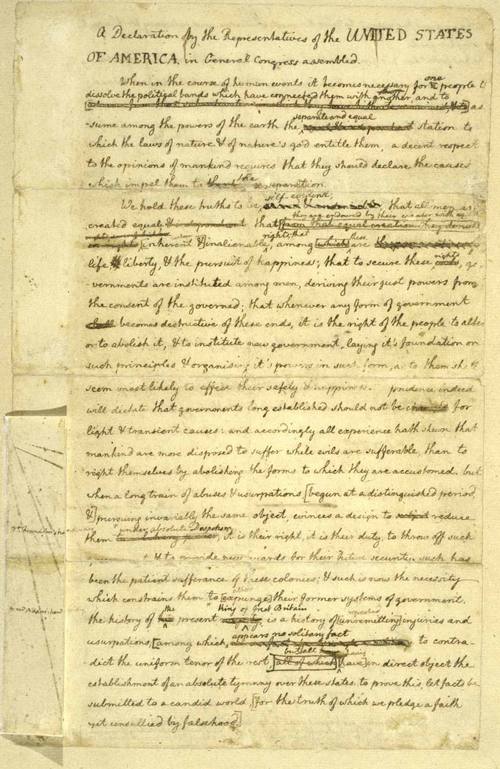
Rough Draft Page 2 Page 3 Page 4

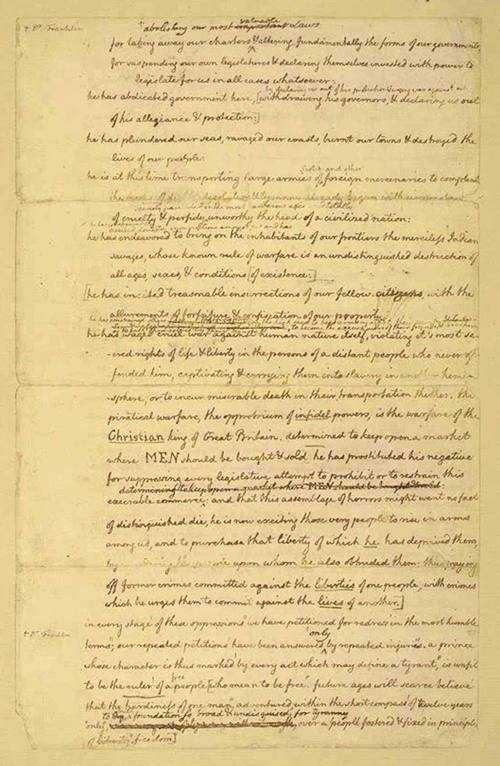

This is the actual "Original Rough Draft" of the Declaration of Independence. Thomas Jefferson wrote this draft from his own notes (of which the fragment of above is one), and gave it to John Adams and Benjamin Franklin who each made some revisions to the text. The changes and corrections you see on the page are the actual changes made by John Adams and Benjamin Franklin. The final version of the Declaration of Independence is somewhat different than this draft because the full Congress debated it and made some additional changes. For the most part though, Jefferson's ideas remained intact.
Read the original draft Thomas Jefferson wrote here.
Read the "Original Rough Draft" version here that was amended by Franklin and Adams.
Read
the final approved Declaration of Independence text here.
Pictures of
the Declaration of Independence -
Dunlap Broadside
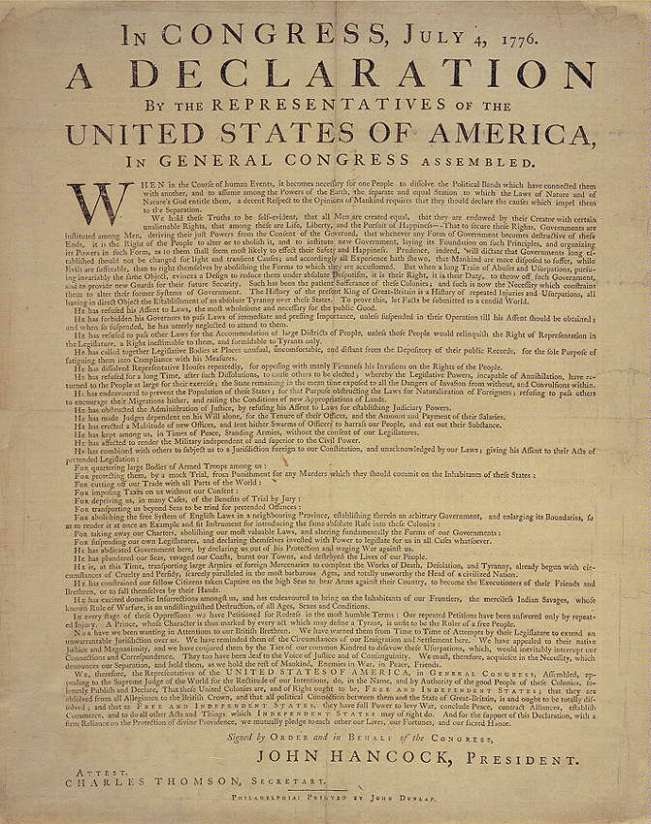
After the Congress approved the Declaration of Independence on July 4th, 1776, the Committee of Five was instructed to have several copies printed up that could be sent to various colonial leaders in the different colonies. The committee took the text to a Philadelphia printer named John Dunlap, who was the official printer of Congress. It is not known for sure how many copies Dunlap made that evening, but most historians believe the number was either 100 or 200 copies. 24 copies of this original printing are known to exist today. See a list of the holders of these copies here.
A broadside is a large piece of paper printed on one side that can be folded into quarters and used as a mailer or cut into several pages for a book. That is why they are called "Dunlap Broadsides." Note that this is the first printing of the Declaration of Independence from July 4th, 1776, and it is without any signatures at all, although it does have these words printed at the bottom, "Signed by ORDER and in BEHALF of the CONGRESS, JOHN HANCOCK, PRESIDENT. ATTEST. CHARLES THOMSON, SECRETARY."
Pictures of the Declaration of Independence
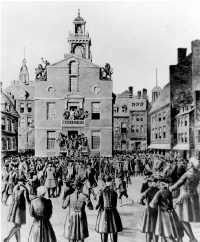
This picture depicts the first public reading of the Declaration of Independence during the Revolutionary War from the steps of the State House in Philadelphia. The Continental Congress had sent copies of the Declaration to all of the colonies and military leaders on July 5th. Colonel John Nixon of the Philadelphia Committee of Safety read the document publicly for the first time in Philadaelphia on July 8th. The Declaration was also read publicly in the cities of Easton, Pennsylvania and Trenton, New Jersey on this day. In Philadelphia, church bells rung all day in celebration of the Declaration of Independence.
The Signing of the Declaration of Independence
"The
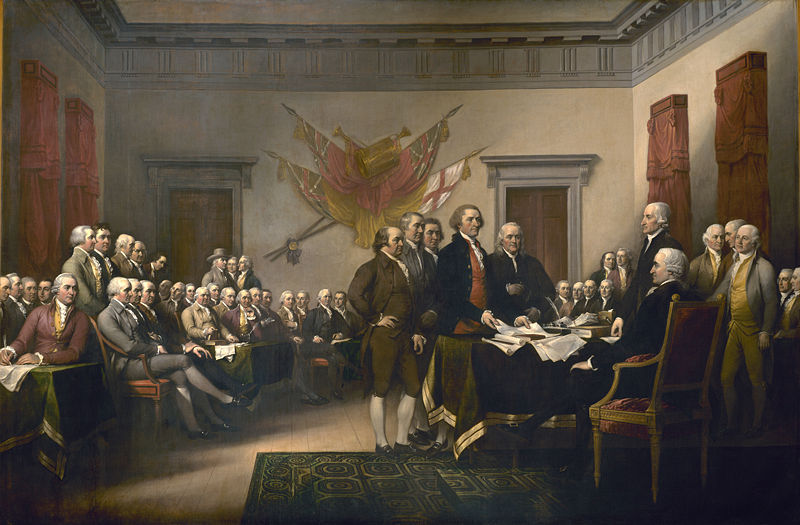
Signing of the Declaration of Independence" by John Trumbull is
probably the most famous of all the pictures of the Declaration of
Independence. It does not depict the actual signing. Instead
it depicts the Committee of Five (John Adams, Thomas
Jefferson, Robert Livingston, Benjamin Franklin and Roger Sherman)
presenting their draft of the Declaration to the full Congress.
Committee of Five Engraving
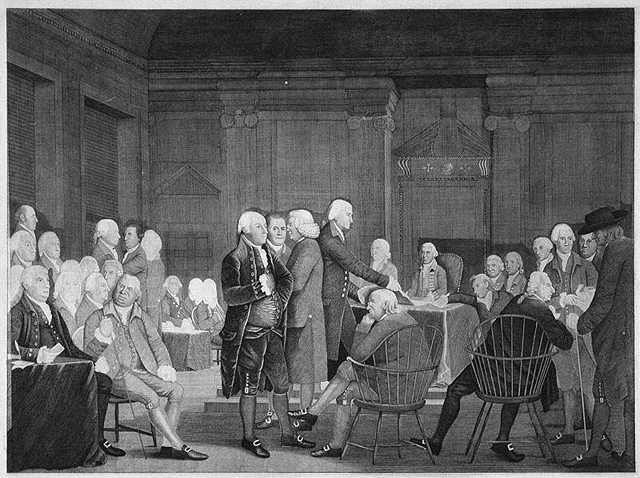 Committee of Five engraving
This is an unfinished engraving by Edward Savage of the Committee of Five presenting their draft of the Declaration of Independence to the full congress. The Committee of Five was the Committee that Congress appointed to write up the Declaration. Thomas Jefferson is standing in the middle and placing the document on the table. John Hancock is sitting behind the table. Benjamin Franklin is sitting in front of the table. The other three members of the committee are standing behind Jefferson, from left to right, John Adams of Massachusetts, Roger Sherman of Connecticut and Robert Livingston of New York. Ironically, Robert Livingston never did sign the Declaration itself. He disagreed with the other members that it was time to break permanently with Great Britain.
Pictures of
the Declaration of Independence -
George Washington's copy

This is a picture of George Washington's personal Dunlap Broadside. This is the very copy of the Declaration of Independence that was sent to General Washington by John Hancock on July 6th, 1776. Read a copy of the letter John Hancock sent to George Washington, with his copy of the Declaration enclosed, here.
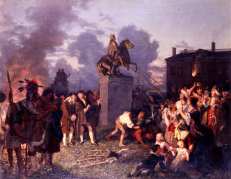
General Washington read the Declaration to his troops in New York City on July 9th. That same evening the townspeople destroyed a bronze statue of King George on Bowling Green.
Pictures of
the Declaration of Independence -
Original signed, engrossed copy
On July 19th, Congress ordered that an engrossed copy of the Declaration be made and signed by all the members of Congress. An engrossed copy is an official document that is hand written in a clear and legible manner. This version was transcribed by Timothy Matlack, a resident of Philadelphia, who was the assistant to the Secretary of the Congress, Charles Thomson. Matlack also wrote the orders for George Washington's appointment as Commander in Chief of the Continental Army. 51 members of Congress signed the document not on July 4th, but on August 2nd, 1776. Another 5 would sign it over the next several months. The list of men who voted for the Declaration, and those who signed it, is somewhat different due to the fact that some who voted for it were not re-elected to Congress. Others took their place and signed when they arrived. Some were gone for personal reasons such as sickness as well.
Pictures of
the Declaration of Independence -
Pennsylvania Packet, July 8, 1776
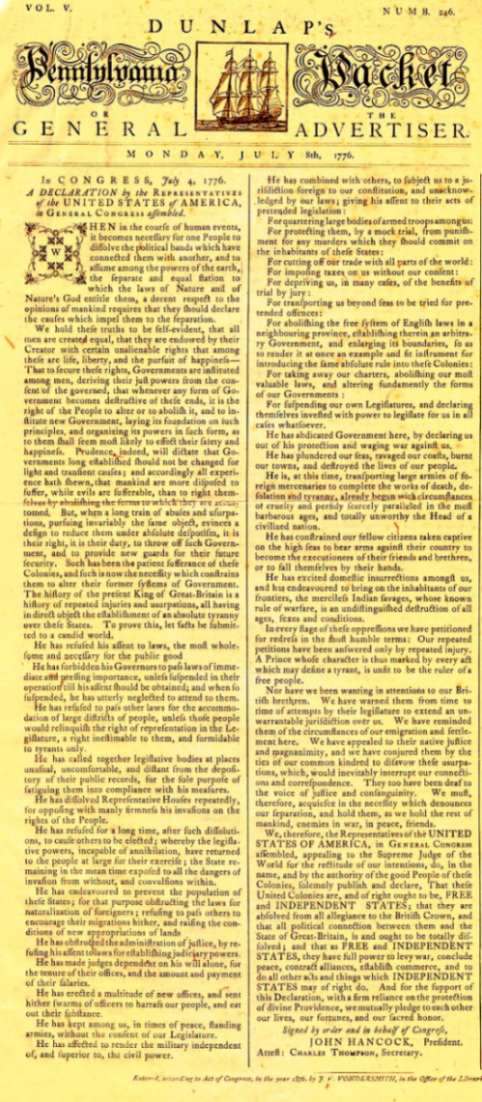
This is one of the earliest newspapers that published a copy of the Declaration of Independence. This copy was printed on July 8, 1776. At the time, the Packet was printed every Monday by John Dunlap, a loyal patriot and the official printer of Congress. The Pennsylvania Packet became the first successful daily newspaper in the United States.
Pictures of
the Declaration of Independence -
Mary Katherine Goddard printing
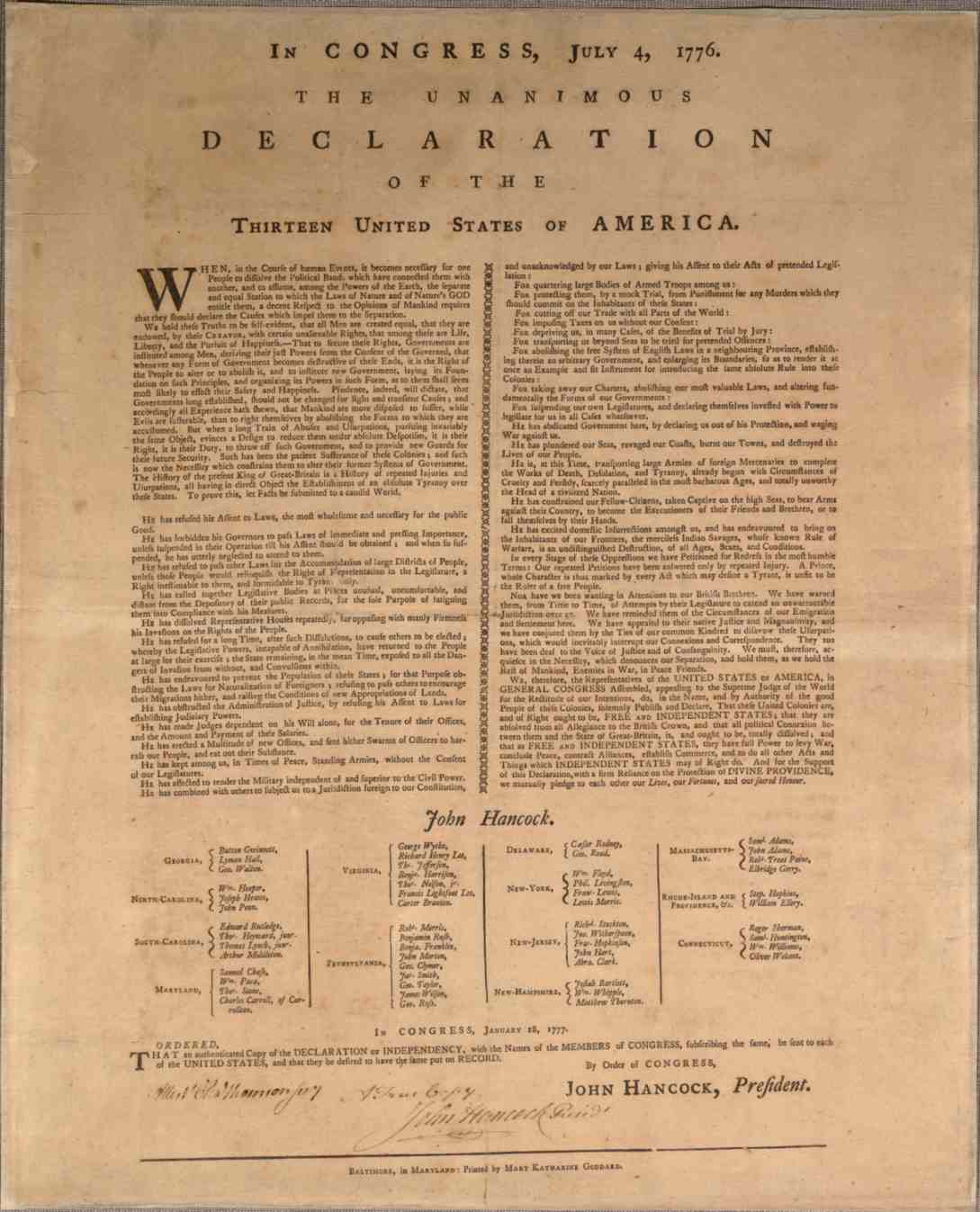
In December 1776, Congress fled from Philadelphia due to the approaching British army. They moved all of their papers, along with the Declaration of Independence, to Baltimore, Maryland. In January, 1777, encouraged by George Washington's recent victories at Princeton and Trenton, the Congress ordered the second official printing of the Declaration. This time they ordered that the names of all the signers be included. The prints were made by Mary Katherine Goddard in Baltimore and distributed throughout the colonies.
Pictures of
the Declaration of Independence -
Stone Engraving
In 1823, Thomas Stone, was commissioned by President John Quincy Adams to create an exact copy of the Declaration of Independence. Stone probably used the "copper transfer method," which included placing a wet sheet of paper over the original Declaration of Independence, which transferred some of the ink to the sheet of paper. The paper was then pressed on a copper plate, transferring the ink to the copper plate. The copper plate was then engraved using the ink as an outline. The plate was then used to create prints. Most of the copies that Americans see today are based on one of Thomas Stone's original 200 copies printed from this plate.
Return
to main Declaration of Independence page here
Go
to Purpose of the Declaration of Independence page here
Go
to list of the Signers of the Declaration here
Go
to Declaration Signatures page here
Go
to Thomas Jefferson and the Declaration of Independence page here
Go
to the Olive Branch Petition page here
Go
to History of the Declaration page here
Revolutionary
War and Beyond Home
Like This Page?
© 2008 - 2022 Revolutionary-War-and-Beyond.com Dan & Jax Bubis
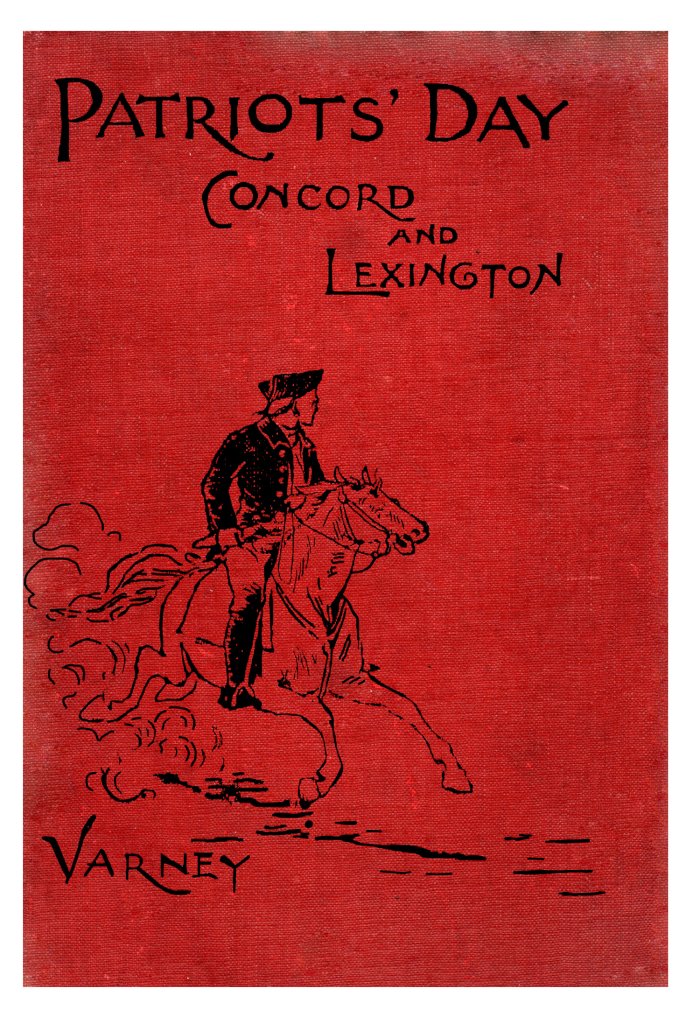
This book is as exact a reproduction of this wonderful little book published in 1895 as we could produce. You will find words spelled and hyphenated the way they are in the original.
Our goal at Battle Road Books is to keep the history of the Revolutionary War alive and vibrant and easily accessible. We also don’t think you should pay an arm and a leg just to read these old books.
Get your Favorite Flag on a coffee mug. Or maybe your favorite Founding Fathers Quote on a travel mug. Custom Orders welcome.

Visit our Sister Site - Revive 1775
YES! You can now sponsor your favorite page on Revolutionary War and Beyond. Click below for information.



Homepage | Newsletter | Causes | Declaration | Bill of Rights | Founders
Facts | Flags | Quotes | Games | Attractions | Documents | Blog | Store | Advertise
 |
|
Privacy | Sitemap | Citations | Contact
Revolutionary War and Beyond © 2008-2019
Facebook Comments